
Analog Archive Blog
VHS RF Capture in 2026: What vhs-decode Actually Does and When It Matters
A practical, technically accurate guide to VHS RF capture, the vhs-decode workflow, and when raw RF preservation is worth the extra complexity.
Key Points
- VHS RF capture records the raw video RF before the deck turns it into normal composite or S-Video output, which makes it fundamentally different from a standard transfer.
- The vhs-decode toolchain works from deck-modified RF captures and produces timebase-corrected data that can then be exported to archive-friendly video files such as FFV1.
- This workflow is powerful for difficult, historically important, or research-grade tapes, but it does not remove the need for a stable transport, clean heads, and correct tracking.
- For many family collections, a strong conventional transfer chain is still the practical choice; RF capture is best treated as a specialized preservation option rather than a default.
What VHS RF capture is and what it is not
In a conventional VHS transfer, the deck demodulates the tape internally and outputs a finished baseband signal such as composite or S-Video. RF capture moves further upstream. Instead of recording the already-decoded video output, it records the raw frequency-modulated video information directly from the machine's RF path so that software can decode it later.
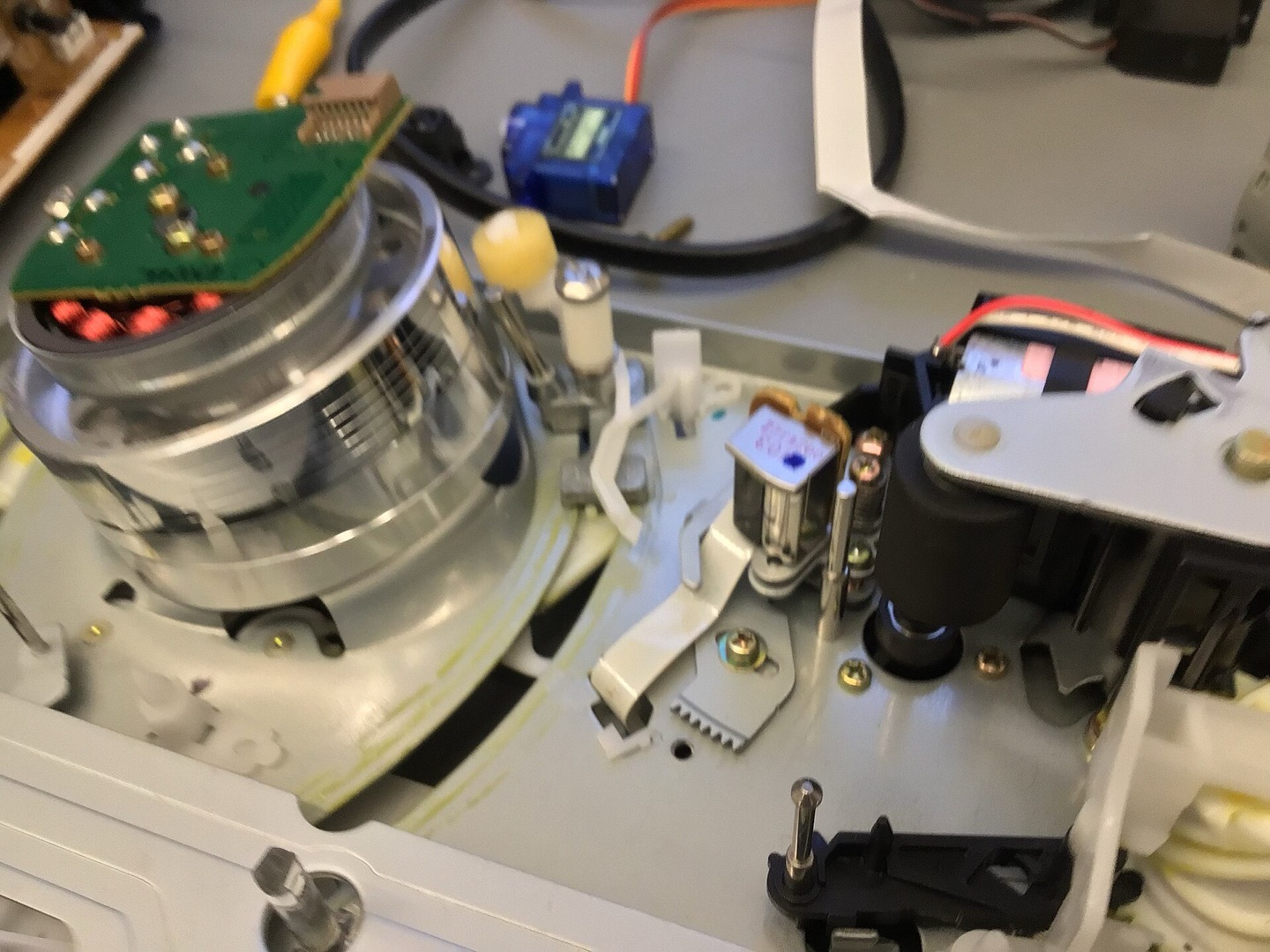
That distinction matters because the software is not trying to polish an already finished consumer output. It is reconstructing the signal from an earlier point in the chain. The official vhs-decode documentation is explicit that this does not mean using the rear RF modulator or antenna connectors on a VCR. It means tapping the video RF from the correct internal points on a compatible deck and digitizing that signal with suitable hardware.
In practical terms, RF capture is closer to preserving an intermediate technical source than making a quick viewing copy. It appeals to archives and experimenters because it preserves more of the original playback information and keeps future decoding options open.
Why people use vhs-decode at all
The main attraction is flexibility. Once raw RF has been captured cleanly, decoding choices can improve over time without replaying a fragile tape. That is especially valuable when the tape is rare, the transport is finicky, or the collection is important enough that one extra pass is not something you want to spend casually.
The vhs-decode project is part of a broader software-defined video preservation approach descended from ld-decode work. Its goal is not to claim that every tape suddenly becomes pristine. The point is that difficult playback behavior, dropouts, chroma recovery, and timing interpretation can often be studied and refined in software when the raw signal has been preserved carefully.
This is why RF capture has become a serious topic in archival circles. It is not because normal transfer is obsolete. It is because software decoding creates a second chance to interpret a playback event more intelligently than a fixed, one-shot hardware chain can.
- It preserves more of the playback event for later analysis and re-decoding.
- It can be useful when a tape is rare, damaged, or historically important enough that replay minimization matters.
- It gives technically inclined users a path to inspect the signal and not just the final exported video file.
What the real workflow looks like
The workflow is more demanding than ordinary capture. First, you need a deck with a known-good transport and the correct RF tap points. Then you need capture hardware that can sample the raw signal with enough bandwidth for VHS RF. The project documentation discusses supported hardware and also notes an important limit that surprises newcomers: inexpensive RTL-SDR devices are generally only suitable for HiFi RF audio capture, not the full VHS video RF path.
After capture, the raw RF recording is decoded with vhs-decode into intermediate files rather than a finished consumer video right away. The FAQ describes the core output as TBC data, and for color-under formats such as VHS it also produces a separate chroma TBC file. Those intermediates are then exported into usable preservation or access files with the project's export tooling.
That means the actual deliverable stack is layered. There is the raw RF capture, there are the decoded intermediate files, and then there is the final archive or viewing export. For institutions or hobbyists who want maximum reversibility, that layered structure is a feature, not a bug.
- Stable VCR with correct internal RF taps
- RF-capable capture hardware and storage planning
- Software decode pass to generate TBC-domain intermediates
- Export pass to create preservation or viewing files
What files you actually end up with
One reason the workflow feels foreign to people coming from standard digitization is that the first output is not usually a simple MP4 or MOV. According to the vhs-decode FAQ, the decode stage produces TBC-domain files, and the project provides export tooling for archival outputs such as FFV1. The Quick Setup Guide also describes the FFV1 export path as the normal preservation-minded destination after decode.
This layered model is useful because it separates signal recovery from presentation. The RF capture preserves the ingest event. The TBC-domain files preserve the software's reconstruction of luminance and chroma timing. The final export is the item most editors, archives, and viewers can handle directly.
The tradeoff is storage and workflow overhead. RF captures are large, decode passes take time, and the process benefits from careful note taking. Anyone considering it should treat file management as part of the preservation job, not as an afterthought.
Where RF capture helps and where it does not
RF capture can be compelling when the tape is irreplaceable, when a researcher wants to preserve as much of the playback event as possible, or when a normal baseband transfer leaves questions that are worth revisiting later. It can also be valuable for method development because people can compare decoder settings and export strategies without touching the original cassette again.
What it does not do is excuse poor playback practice. Tracking still matters. Mechanical stability still matters. Head condition still matters. If the transport damages the tape or mistracks badly, software cannot recover information that never reached the capture cleanly in the first place.
That is the right way to think about vhs-decode: as a more preservation-oriented and software-flexible capture approach, not as magic recovery dust sprinkled on top of a bad machine.
How this compares with a conventional transfer service
For many client jobs, a disciplined conventional transfer chain is still the correct answer. A good deck, deck-side stabilization, external full-frame correction where needed, and a clean native-resolution master can get families and collectors exactly what they need without the cost and complexity of RF work.
RF capture starts to make sense when the project is unusually important, unusually difficult, or unusually technical. It is better framed as a specialized preservation path for edge cases and research-minded archives than as the automatic default for every home movie tape.
That distinction is healthy for clients because it separates marketing hype from workflow reality. A conventional archival transfer should be strong on its own merits. RF capture is valuable because it expands the preservation toolbox, not because it invalidates every other method.
If a service provider talks about VHS RF capture, ask whether they mean true internal RF tapping and software decode, or just ordinary capture from a VCR's standard outputs. The two workflows are not the same.